
Turn 1 Source Into 6+ Launch Assets In Minutes with AI
How to use Google’s free NotebookLM to spin up blogs, FAQs, audio guides and more

🔍 What’s the insight?
Using Google’s NotebookLM to quickly create all the promo assets you need for a project launch
🛠 What tool am I using?
NotebookLM from Google (currently free)
🤖 How does it work?
Step 1: Open NotebookLM and hit the ‘create new’ button.
Step 2: Add your source(s). For example, if you’re launching a new report, add in the finished report and any other assets you might have for it.
To demonstrate how this works, I’ve used a PDF of Jasper's State of AI in Marketing Report, which is available here.
Step 3: Once you’ve added all your sources, name the notebook and head to the chat tab, where you can ask it to create specific content like copy for a blog post, social media posts, and a press release.
The tab, studio, suggests ways to convert the content, like turning it into a podcast between two hosts or creating an FAQ document, a study guide, or a briefing doc.
Pro Tip: Each time you create new content, save it as a note in the notebook and name it appropriately so you can keep track of everything you’ve created.
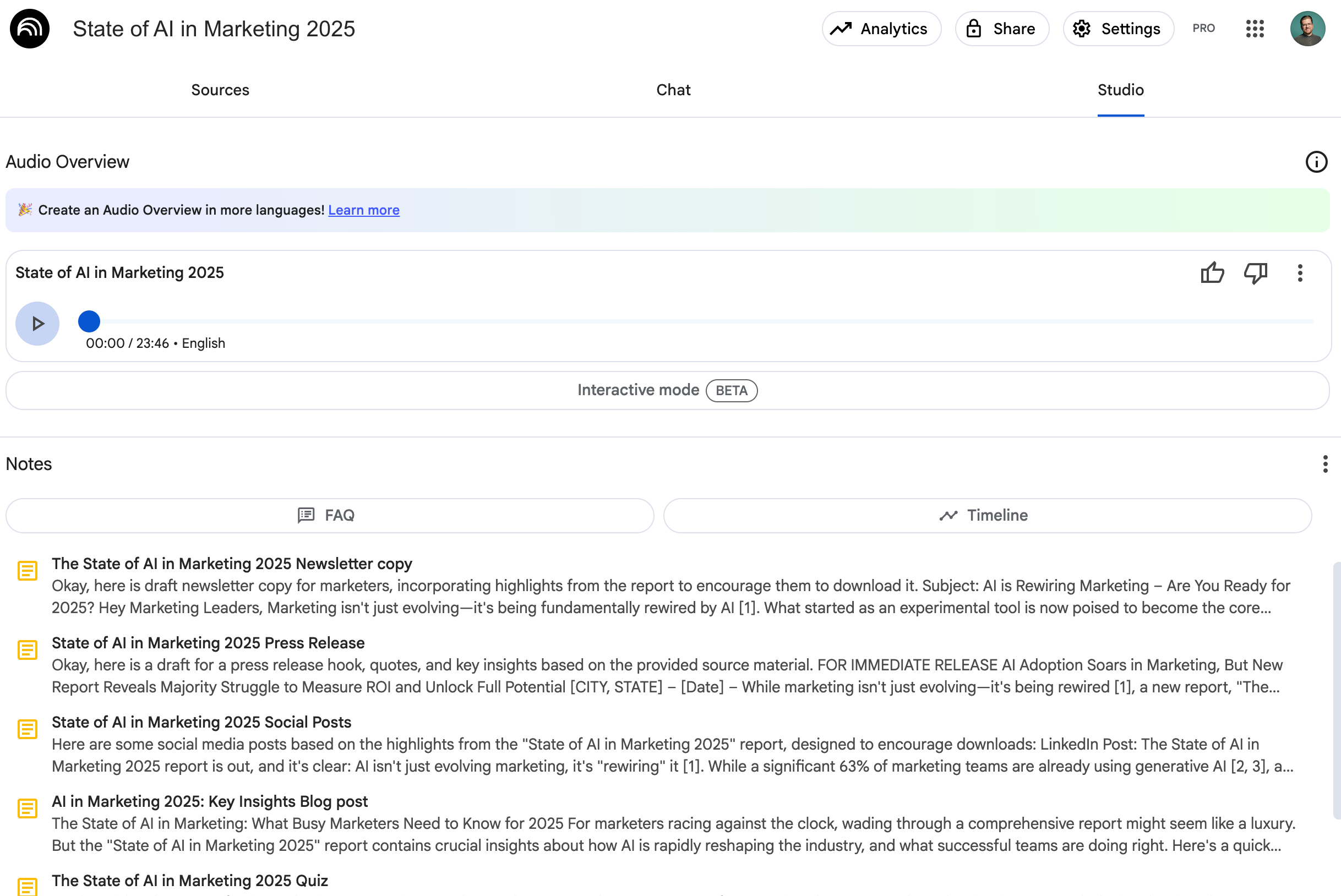
Based on the report, I was able to create the following content in just a few minutes:
Launch press release
Blog post
Newsletter copy
Social post copies
23-minute audio guide
Quiz
FAQs document
✅ Why I love it:
This is a game-changer for anyone who works in content. Obviously, you will want to tweak and likely adapt some of the copy to ensure it reflects your brand’s tone and includes the relevant information you want to share, but this dramatically reduces the amount of time it takes to produce promo assets for big launches.
For more tips on marketing smarter with AI, follow me over on LinkedIn here.
P.S. For those interested, here are all the assets I produced from the report (note I removed the links so you will see source numbers throughout, but you get the idea):
PRESS RELEASE:
FOR IMMEDIATE RELEASE
AI Adoption Soars in Marketing, But New Report Reveals Majority Struggle to Measure ROI and Unlock Full Potential
[CITY, STATE] – [Date] – While marketing isn't just evolving—it's being rewired1, a new report, "The State of AI in Marketing 2025," unveils a critical gap: despite widespread adoption of generative AI, most marketing teams are still in early stages of implementation, often failing to track its return on investment (ROI) or leverage it for high-impact outcomes. The report highlights that AI is positioned to become the core engine driving every campaign and workflow, yet the path to true AI-driven marketing excellence requires moving beyond ad hoc use to strategic, measured deployment.
Loreal Lynch, Chief Marketing Officer at Jasper, commented on the report's significance, stating, "Generative AI started as an experimental tool but is now positioned to become the core engine driving every campaign, workflow, and initiative. And the proof is in the research: AI is delivering real results for marketing leaders, driving higher productivity, better marketing ROI, and increased employee satisfaction. So much so that 79% of companies plan to expand AI adoption in 2025"2.
She added, "This report is more than research. It’s a benchmark, a guide, and a call to action. My hope is that this report sparks new ideas, challenges old assumptions, and helps your marketing team navigate the AI transformation with confidence"3.
Key insights from the report for busy marketers include:
High Adoption, Early Stages: A significant 63% of marketing teams currently use generative AI, with another 27% evaluating within the next six months4.... However, 56% of adopters still rely on ad hoc, siloed applications, and only 10% report "very advanced" AI maturity2....
The ROI Measurement Gap: Despite improved marketing ROI being cited as a leading benefit, only 49% of companies track the ROI of their AI investments2.... This ability to measure ROI drops significantly when using only general-purpose tools, with only 20% able to do so7....
Untapped High-Value Use Cases: While AI is widely used for content creation (57%) and idea generation (55%)10, high-value "agentic" capabilities like brand governance, hyper-personalization, workflow automation, and predictive optimization remain underutilized4....
Domain-Specific AI as a Differentiator: Companies investing in domain-specific AI—models tailored to their unique data and brand guidelines—are 37% more likely to measure ROI than those using general-purpose tools9.... This is a defining trait of high-maturity marketing organizations13....
Budgets and Expansion Set to Soar: AI is becoming a core budget priority, with the typical allocation expected to rise from less than 5% in 2024 to 11-15% in 202515. Overall, 79% of companies plan to expand AI adoption in the coming year2....
The report underscores that the risk for marketing teams isn't AI itself, but rather "the risk of being left behind" as AI-driven marketing becomes the industry standard.
BLOG POST:
The State of AI in Marketing: What Busy Marketers Need to Know for 2025
For marketers racing against the clock, wading through a comprehensive report might seem like a luxury. But the "State of AI in Marketing 2025" report contains crucial insights about how AI is rapidly reshaping the industry, and what successful teams are doing right. Here's a quick rundown of the most interesting takeaways you need to know:
AI is Everywhere, But Not Always Effectively Used1...
The good news: 63% of marketing teams are already using generative AI3..., and another 27% are evaluating it for the next six months5.... This isn't just experimentation anymore; it's seen as becoming a core engine for campaigns and workflows1.... Early adopters are reporting significant wins, with increased productivity (28%) and improved marketing ROI (25%) being the top benefits cited6.... AI is even boosting job satisfaction, with 78% of marketers reporting higher morale due to its use6....
However, there's a significant catch. While adoption is high, 56% of adopters still rely on ad hoc, siloed applications, often disconnected from their existing workflows1.... Only a small fraction (10%) report "very advanced" AI maturity6.... This indicates that many are stuck in the early stages, using AI for basic tasks like content creation (57%) and idea generation (55%)2....
The Gap Between Adoption and Impact12
Simply adopting AI isn't enough to realize its full potential1. The report highlights a critical gap between adoption and measurable impact12. A surprising only 49% of companies track the ROI of their AI investments, although another 22% plan to start in 20251.... This measurement gap is particularly pronounced for users of general-purpose AI tools, with only 20% able to measure ROI13....
The key to closing this gap? Moving beyond generic tools to domain-specific AI12.... These models are tailored to a company's unique data, brand guidelines, and marketing workflows12. High-maturity organizations are significantly more likely to use domain-specific AI (71% of "very advanced" teams) compared to relying solely on general-purpose tools (21%)15. Domain-specific AI users are also 37% more likely to measure ROI14... and nearly all plan to expand usage in 2025 (92%)16. Investing in this type of AI is a defining trait of high-maturity teams12....
Unlocking High-Value Use Cases and Formalizing AI2...
While content creation is common, high-value capabilities like brand governance (29%), hyper-personalization (28%), workflow automation (26%), and predictive optimization (23%) remain largely underutilized2.... These "agentic" use cases represent the next evolution, allowing AI to take on more autonomous, decision-making roles2....
Mature marketing teams are actively building the structure to scale AI18. This includes formalized AI programs (only 43% of adopters have one)3, establishing a marketing-specific AI council (49% have one, 16% plan one by 2025)19..., offering advanced AI training (only 25% do)20..., and documenting AI policies and guidelines (only 46% have documented policies)21.... These elements are hallmarks of high-maturity organizations22....
Barriers and Future Outlook13...
Top barriers to adoption include data privacy (21%) and concerns about output quality (19%)13.... Leadership buy-in, lack of expertise, and budget constraints are also ongoing hurdles13.... Interestingly, fear of job loss and difficulty measuring general impact are less pressing concerns for most13.... Company size impacts priorities, with larger enterprises focusing on output quality and brand governance, while smaller businesses worry more about data privacy and budget28....
Looking ahead, AI budgets are set to surge in 2025, with the allocation expected to rise from typically less than 5% in 2024 to 11-15%25.... 79% of companies plan to expand AI adoption1.... Marketers also anticipate a significant shift in team roles and structures, with nearly half (48%) expecting a "great impact"26....
The Blueprint for 202534
The message is clear: AI is no longer optional35. The blueprint for success involves moving beyond basic tasks and ad hoc use to structured implementation, leveraging domain-specific tools, focusing on high-value use cases, formalizing strategies, and prioritizing quality and brand consistency17.... For marketers who don't want to be left behind, the time to act strategically is now35....
NEWSLETTER COPY:
Subject: AI is Rewiring Marketing – Are You Ready for 2025?
Hey Marketing Leaders,
Marketing isn't just evolving—it's being fundamentally rewired by AI1. What started as an experimental tool is now poised to become the core engine driving campaigns, workflows, and initiatives2. The data is clear: AI is delivering real results, from boosting productivity to improving marketing ROI and even increasing job satisfaction2....
But here's the critical insight from our new "State of AI in Marketing 2025" report: Adoption alone isn't enough2.
While a significant 63% of marketing teams are already using generative AI3..., and an overwhelming 79% plan to expand adoption in 20252..., the majority are still in the early stages2. A striking 56% rely on ad hoc, siloed applications, disconnected from their core workflows2..., and only 10% report "very advanced" AI maturity3....
This disconnect between trying AI and truly embedding it strategically is the key challenge highlighted in the report. Many marketing teams are missing out on AI's full potential, especially when it comes to measuring impact and leveraging high-value use cases.
Here are some key takeaways from the report you need to know:
The Measurement Gap is Real: Despite improved marketing ROI being a top benefit cited, only 49% of companies actually track the ROI of their AI investments2.... This ability to measure ROI drops sharply when using only general-purpose tools10....
Domain-Specific AI is a Game Changer: The report reveals that companies investing in domain-specific AI—models tailored to their unique data, brand guidelines, and workflows—are 37% more likely to measure ROI than those using general-purpose tools11.... This isn't just a best practice; it's a defining trait of high-maturity organizations12....
High-Value Use Cases Remain Untapped: While widely used for content creation (57%) and idea generation (55%)15..., AI is less leveraged for high-impact "agentic" capabilities like brand governance (29%), hyper-personalization (28%), workflow automation (26%), or predictive optimization (23%)16.... Moving beyond basic tasks is the next frontier for unlocking scalable, consistent performance17.
Formalizing Efforts is Crucial for Scale: Only 43% of adopters have a formalized AI program in place6.... Establishing marketing-specific AI councils (49% of adopters have one)19 and offering advanced AI training (only 25% of companies do)20 are hallmarks of high-maturity teams that are positioned to scale effectively14....
Budgets Are Set to Surge: Marketing AI budgets are expected to rise significantly, from less than 5% in 2024 to 11-15% in 20257..., signaling growing confidence in AI's long-term value22.
Roles and Structures Will Reshape: Marketers expect AI to have a significant impact on team roles and structures, with 48% predicting a "great impact"23....
The report makes it clear: the risk isn't AI itself—it's the risk of being left behind25.... As AI-driven marketing becomes the industry standard, teams that fail to integrate AI strategically will struggle to keep pace26.
This report is more than just research; it's a benchmark, a guide, and a call to action25. It offers a blueprint for 202527, detailing how leading teams are moving beyond surface-level adoption to unlock AI's full potential for strategic advantage, efficiency, and amplified creativity28....
Don't miss out on the key trends, challenges, and winning strategies that will define marketing in the year ahead.
Download your free copy of "The State of AI in Marketing 2025" report today and discover how to navigate the AI transformation with confidence25!
[Insert Download Link Here]
SOCIAL POSTS:
LinkedIn Post:
The State of AI in Marketing 2025 report is out, and it's clear: AI isn't just evolving marketing, it's "rewiring" it1.
While a significant 63% of marketing teams are already using generative AI2..., and 79% plan to expand adoption in 20254..., the report reveals a critical challenge: simply using AI isn't enough to see its full potential4.
Key takeaways for busy marketers:
• Early adopters report real benefits: Increased productivity (28%) and improved marketing ROI (25%) are top2.... AI is even boosting job satisfaction for 78% of adopters2....
• The gap between adoption and impact is real: 56% still use ad hoc, siloed applications3..., and only 10% report "very advanced" maturity2.... A striking only 49% of companies track the ROI of their AI investments4....
• High-maturity teams lean on domain-specific AI: Companies using models tailored to their data/brand are 37% more likely to measure ROI10... and nearly all plan to expand usage11.... This is a defining trait of leading organizations13.
• High-value use cases like brand governance, personalization, and automation remain underutilized2.... Moving beyond basic content creation is the next frontier15.
• Formalizing AI efforts is crucial for scale: Only 43% of adopters have a formalized program16. Establishing marketing-specific AI councils (49% have one)17 and providing advanced training (only 25%)18 are hallmarks of mature teams18....
• AI budgets are set to surge in 2025, expected to rise from <5% to 11-15%20.
• Marketers expect AI to significantly reshape roles and structures (48% predict "great impact")21.
The report highlights that the risk isn't AI itself, but "the risk of being left behind"22. Don't miss out on the blueprint for AI success in 2025.
Download the full report to understand the key trends, challenges, and winning strategies: [Insert Link Here - Note: Link is not from the source document]
#AIMarketing #MarketingStrategy #GenerativeAI #MarketingTech #MarketingROI #FutureOfMarketing
--------------------------------------------------------------------------------
X (formerly Twitter) Post:
🚨 New Report Alert! 🚨 The State of #AIMarketing 2025 is here.
🔥 63% of teams use GenAI2..., 79% will expand in 20254.... 🚀 Top benefits: Productivity & ROI2.... 🤔 But... 56% use ad hoc tools3..., only 49% measure ROI4.... 🔑 Domain-specific AI is key to measuring ROI (users 37% more likely!)10.... 📈 Budgets jump to 11-15% in '2520. 👥 Roles will change! 48% expect great impact21.
Don't get left behind22. Get the insights you need! 👇
Download the full report: [Insert Link Here - Note: Link is not from the source document]
#Marketing #GenerativeAI #MarketingTech #MarketingStrategy #Data
--------------------------------------------------------------------------------
Facebook Post:
Curious about how AI is really changing marketing? We've got the answers in the new "State of AI in Marketing 2025" report!
It turns out, while most marketing teams are jumping on the AI train (63% are already using generative AI!2...), many are still in the early stages, just experimenting2....
The report dives deep into why some teams are seeing HUGE results (like increased productivity and marketing ROI2...), while others are struggling to measure impact (only 49% actually track AI ROI4...).
Want to know the secret sauce of high-performing AI marketing teams? They're not just using generic tools; they're investing in domain-specific AI tailored to their brand11..., formalizing their AI strategies with programs and councils16..., and focusing on higher-value uses beyond just content creation2....
Big changes are coming – AI budgets are expected to significantly increase20, and marketers anticipate it will reshape team roles21.
If you want to move beyond basic AI use and truly embed it for strategic advantage, this report is a must-read! Don't risk being left behind22.
Download your copy today! [Insert Link Here - Note: Link is not from the source document]
#MarketingTips #AIMarketing #GenerativeAI #BusinessGrowth #MarketingAutomation #DigitalMarketing
AUDIO GUIDE:
QUIZ:
According to the report, what percentage of companies plan to expand AI adoption in 2025, and why is adoption alone not considered sufficient?
What are the top two leading benefits cited by marketers who have adopted AI?
What percentage of marketers currently self-report as having "very advanced" AI maturity? What does this suggest about the overall state of AI adoption in marketing?
Identify the top two perceived barriers to AI adoption in marketing, according to the report.
How does the use of domain-specific AI tools correlate with the ability to measure ROI on AI investments?
What is a Marketing AI Council, and what percentage of AI adopters have already established one?
According to the report, what is the primary focus of AI use cases in marketing currently, and where does adoption drop sharply?
What is the CMO-team alignment gap regarding AI maturity and leadership commitment?
What is the projected shift in the percentage of marketing budget allocated to AI from 2024 to 2025?
What is one of the key defining traits of high-maturity marketing organizations regarding AI adoption strategy?
Quiz Answer Key:
79% of companies plan to expand AI adoption in 2025. Adoption alone is not sufficient because the majority still rely on ad hoc and early-stage applications, disconnected from existing tech stacks or workflows.
The top two leading benefits cited are increased productivity and improved marketing ROI.
Only 10% of marketers self-report "very advanced" AI maturity. This suggests that while AI usage is growing, most organizations are still in the early or ramping stages of integrating AI effectively.
The top two perceived barriers are data privacy or security concerns and concerns about output quality.
Companies using domain-specific AI tools are significantly more likely (37%) to measure the ROI of their AI investments compared to those relying on general-purpose AI.
A Marketing AI Council is a dedicated group within the marketing organization focused on AI implementation and governance. 49% of AI adopters have already established one.
Currently, the primary focus is on content creation and idea generation. Adoption drops sharply in high-value areas like brand governance, hyper-personalization, workflow automation, and predictive optimization.
The CMO-team alignment gap refers to the difference in perception between CMOs and their teams regarding leadership commitment to AI and the organization's AI maturity level, with CMOs generally being more confident.
The percentage of marketing budget allocated to AI is expected to grow from less than 5% in 2024 to 11-15% in 2025.
One key defining trait is the adoption of domain-specific AI tools, as 71% of "very advanced" organizations use these compared to those only using general-purpose tools.
FAQs:
1. How widespread is AI adoption in marketing, and what are the primary benefits observed?
Generative AI adoption is becoming increasingly common in marketing, with 63% of marketing teams currently using it and another 27% planning to evaluate it in the next six months. The most cited benefits of AI adoption include increased productivity and improved marketing ROI. Additionally, a significant positive impact on employee job satisfaction is reported, with 78% of marketers stating higher satisfaction levels.
2. What is the current state of AI maturity in marketing organizations, and where do most teams stand?
Despite the growing adoption, AI maturity in marketing is still in its early stages. Only 10% of marketers self-report a "very advanced" AI maturity level. The majority of adopters (56%) are still utilizing AI on an ad hoc or individual task basis, often disconnected from existing workflows. This indicates that while experimentation is prevalent, a formalized, integrated approach to AI is not yet widespread.
3. What are the main barriers preventing broader and more mature AI adoption in marketing?
The top identified barriers to AI adoption are concerns around data privacy and security (21%), followed by concerns about AI output quality (19%). Other significant hurdles include lack of internal expertise, limited leadership support, insufficient budget or resources, and integration difficulties. Interestingly, concerns about measuring AI impact and job security rank among the least pressing obstacles.
4. How does company size influence AI adoption priorities and approaches?
Larger enterprises (>$1B) prioritize AI output quality and brand governance to protect brand integrity and manage risks. Mid-sized companies ($100M–$250M) are often still in the experimentation phase and face challenges with leadership trust and investment, as well as concerns over output quality. Smaller businesses ($50M–$100M) are primarily concerned with data privacy and budget constraints. Larger marketing teams (500+ employees) are also more likely to have formalized AI programs and use domain-specific AI tools.
5. Beyond basic content creation, what are the untapped high-value use cases for AI in marketing?
While AI is widely used for content creation (57%) and idea generation (55%), adoption drops significantly for more advanced, agentic capabilities. Less than a third of marketers utilize AI for brand governance (29%), hyper-personalization (28%), workflow automation (26%), or predictive optimization (23%). These areas represent significant opportunities for companies to move beyond basic efficiency gains and achieve full-scale AI transformation.